

Book Snapshot: Picky
“We’re all swimming in a culture of pickiness," this book says. Why are kids in the U.S. such picky eaters? And is it bad?

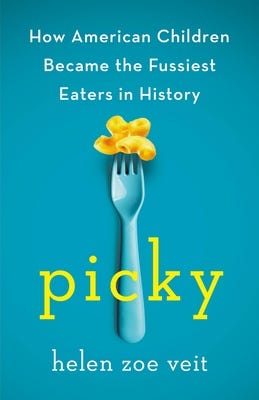
In Picky, Helen Zoe Veit examines the larger systems that create kids who are picky eaters. The book is interesting because Helen Zoe Veit takes us beyond the kid who will only eat white food, or chicken nuggets, to the larger forces that shape our parenting.
Veit reminds us that for most of human history kids ate what their parents ate, and this is still common in other countries. In the U.S., the idea of special food for kids emerged as part of the late 1800’s / early 1900’s reform movements. Temperance, breakfast cereal and bland food for kids all have the same roots.
Veit notes that being choosy about food is tied to social class, and has a racist element. “White Americans sometimes claimed that Chinese people or African Americans would eat just about anything, whereas civilized adults like themselves had the discernment and delicacy to be choosy about what they put in their mouths. Yet wealthy children in the nineteenth century were usually just as omnivorousness as their less privileged peers. Children’s eagerness to eat was a cross-class phenomenon then, just as pickiness is a cross-class phenomenon now.”
“Today, the culture of pickiness is everywhere we look. It’s in the thousands of ads and packages that insist children need special products. It’s in school lunch offerings that look like fast food, and in microwaves that come preset with Kids Meal buttons for Mac & Cheese, Hot Dog, and Chicken Nuggets.”
Veit hopes that parents will reclaim their own wisdom about food. She notes, “in most parts of daily life we’re confident that parents are wiser than preschoolers, and we’re confident that kids can get used to all sorts of things they initially fear or reject. We don’t think of ourselves as “forcing” children to do something against their will when we manage to shimmy the toothbrush past the clamped jaws most nights. If we reflect on it at all, we think that good parents teach children to do what’s safest and best for them, even if it upsets them temporarily. If we heard about a parent who always let a child decide whether to wear a seat belt or brush their teeth or go to school, we’d find it strange. We might call it bad parenting. Food used to be in the parents-are-wiser-than-preschoolers category, too.”
There are systemic problems, too, with cuts to food aid. Many families simply don’t have enough food, or access to fresh food. They would love to feed their kids more nutritious food. Veit adds, “A child’s pickiness can push the whole family to eat junkier meals, leading to weight gain and poor nutrition.”
What do you think? Are their picky eaters at your house? Are you a picky eater? I’d love to hear your comments.

Very interesting- added book to queue, my five year old used to be open to all foods, then he started pre-k at the elementary school and now he’s one of the “picky” ones.
Thanks for this, Mary!
Thanks Mary. I think the insight about the systemic challenges of poverty to food selection and overall health is critical here.